Quick answer: Buy a food cart if your budget is under $15,000, you plan to run it yourself, and you want to break even in under 12 months. Buy a food truck if you need a full commercial kitchen, serve 100+ orders per peak hour, and can invest $50,000–$175,000. Carts cost 10–20 times less upfront, are cheaper to permit, and can be deployed in multiples — trucks win on menu depth and all-weather volume.
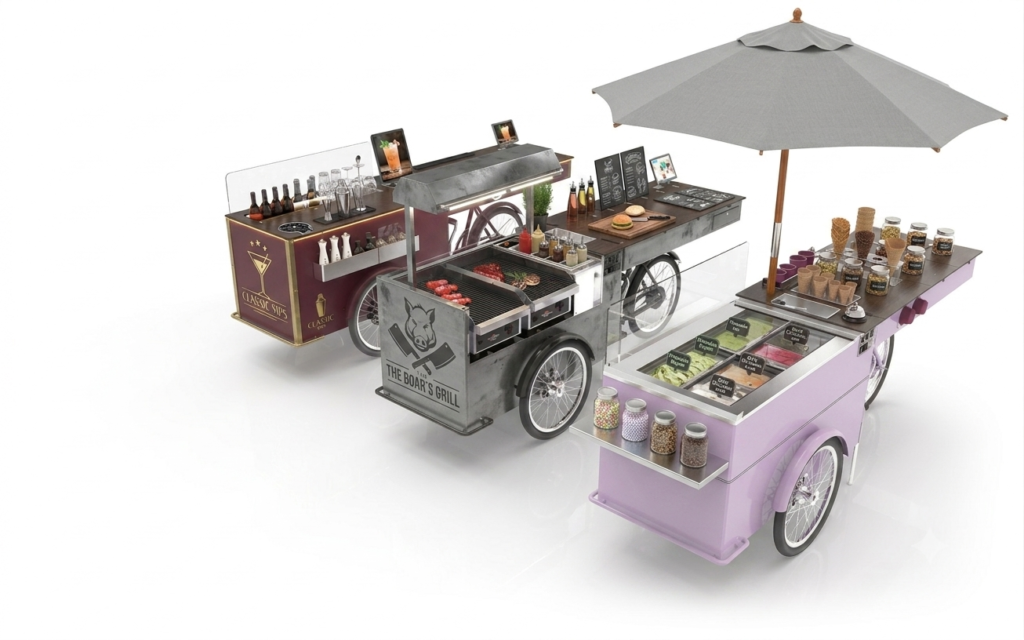
Both models sell street food, but they are different businesses. This guide compares startup cost, permits, equipment capacity, power, staffing, and payback period — with factory-direct pricing from MAG-STAR CHEF, a food cart manufacturer in Wenzhou, China. New to the cart world? Read What Is a Food Bike? Complete Guide first, then the full food cart price breakdown.
Food Cart vs Food Truck at a Glance
| Factor | Food Cart | Food Truck |
|---|---|---|
| Startup cost | $3,600–$11,000 delivered | $50,000–$175,000 |
| Permit difficulty | Low–moderate (pushcart license) | High (vehicle + health + commissary) |
| Menu capacity | 3–8 items, 1–2 cooking stations | Full kitchen, 15+ items |
| Power | Lithium battery, silent | Generator or shore power, noisy |
| Staffing | 1 person | 2–3 people typical |
| Break-even | 3–10 months | 18–36 months |
| Daily cost to run | $15–$40 (charging, restock) | $80–$200 (fuel, generator, commissary) |
What a Food Cart Actually Is (and Isn’t)
A modern food cart is not the rusty hot-dog stand of the 1990s. Today’s carts are welded stainless-steel units with food-grade worktops, lithium battery systems, refrigeration, and full branding — they simply lack the vehicle chassis. Many are technically food bikes or food trailers: either pedal/electric-assisted or towable behind any car.
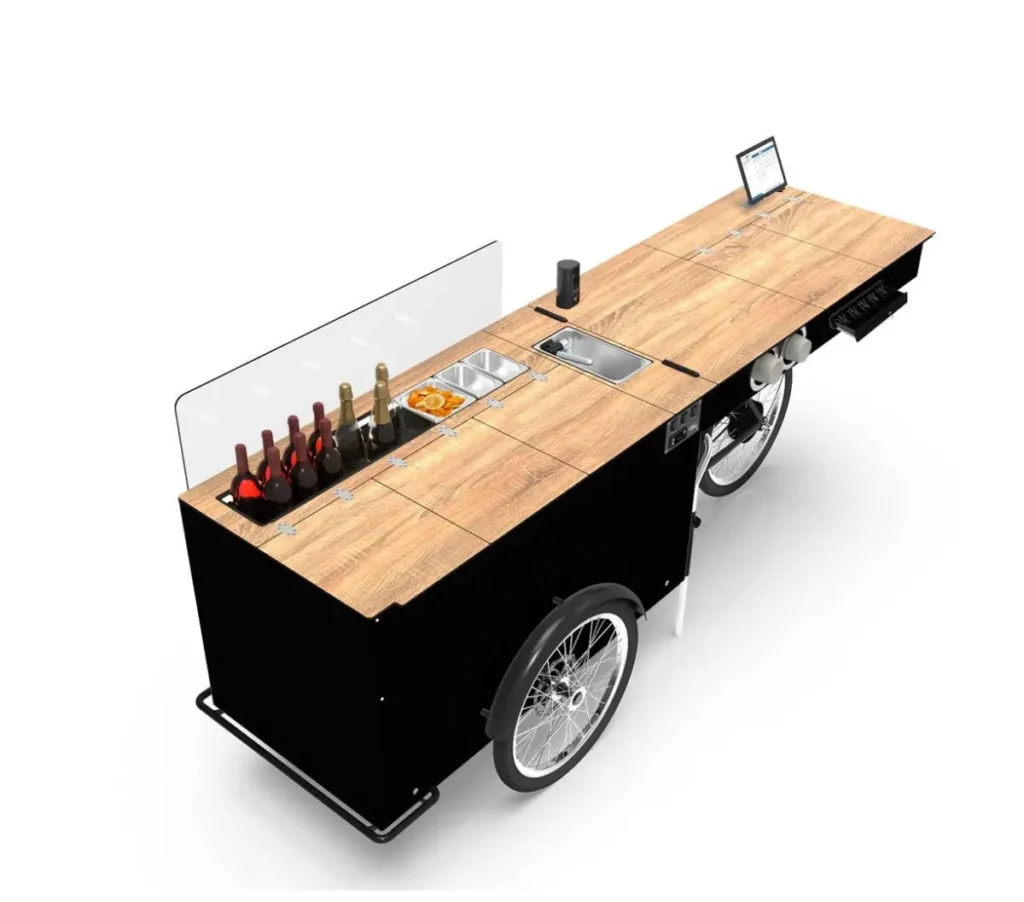
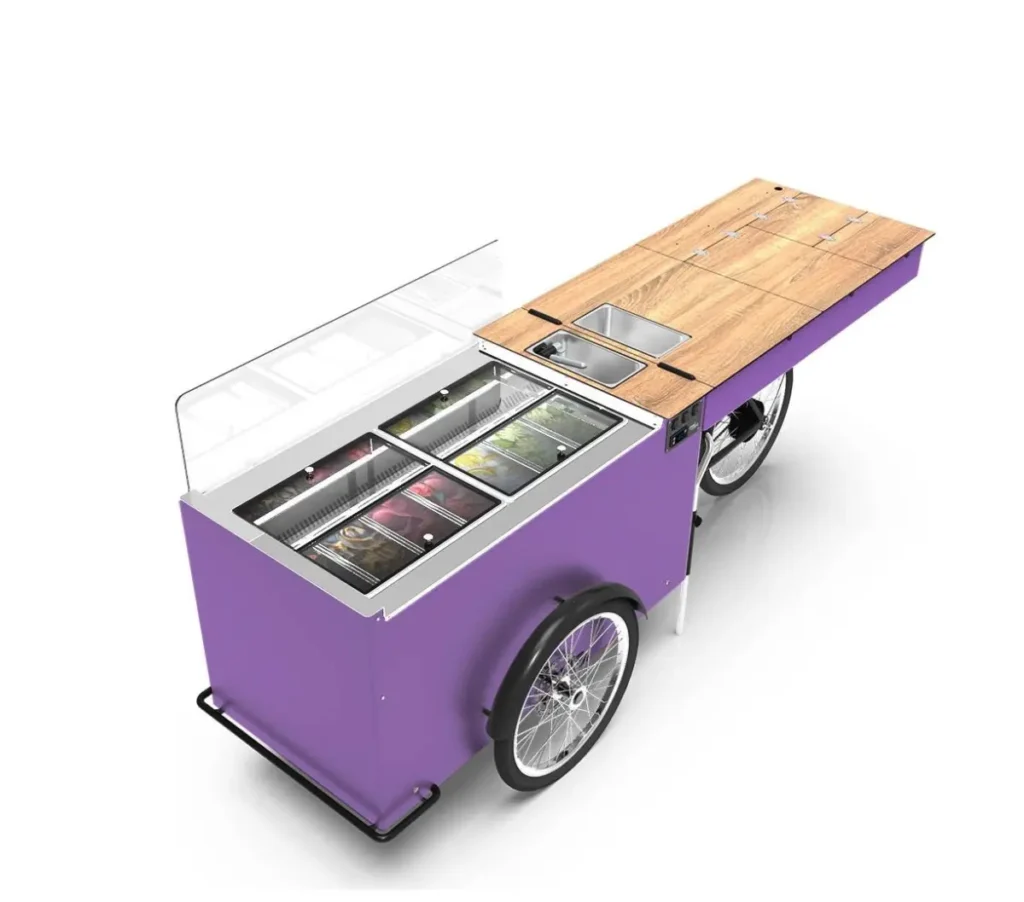
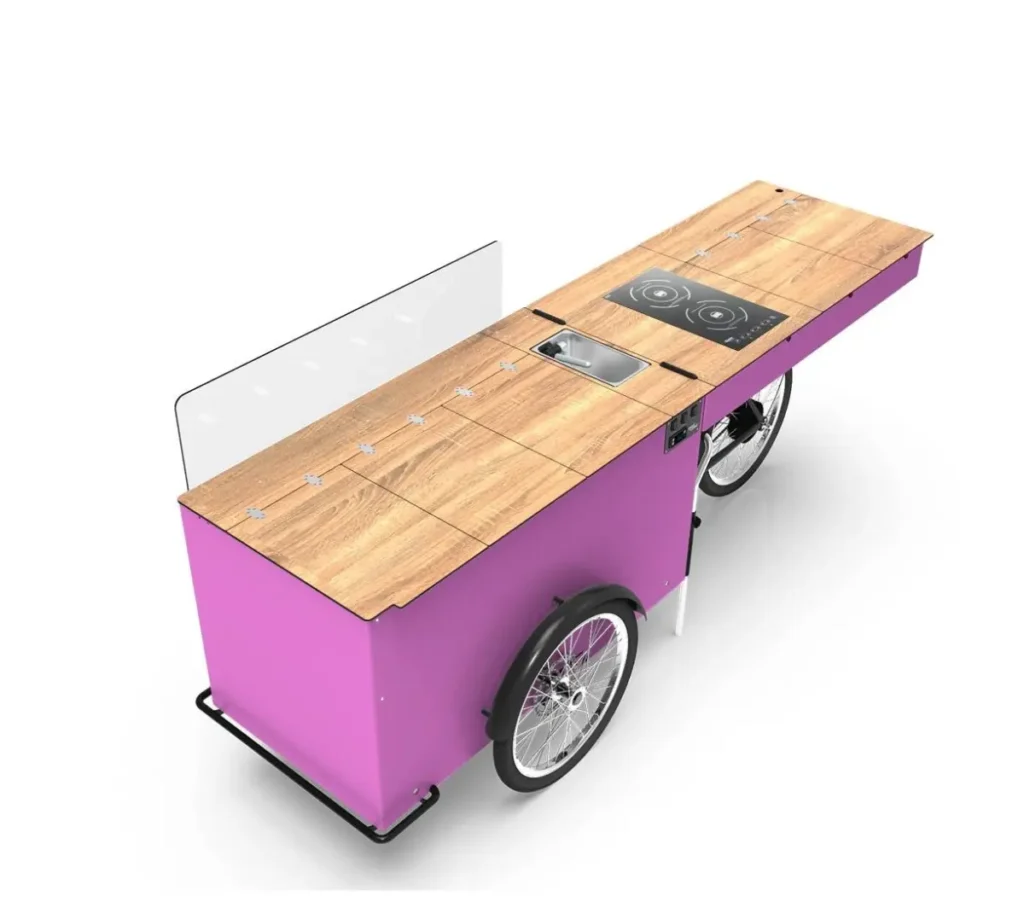
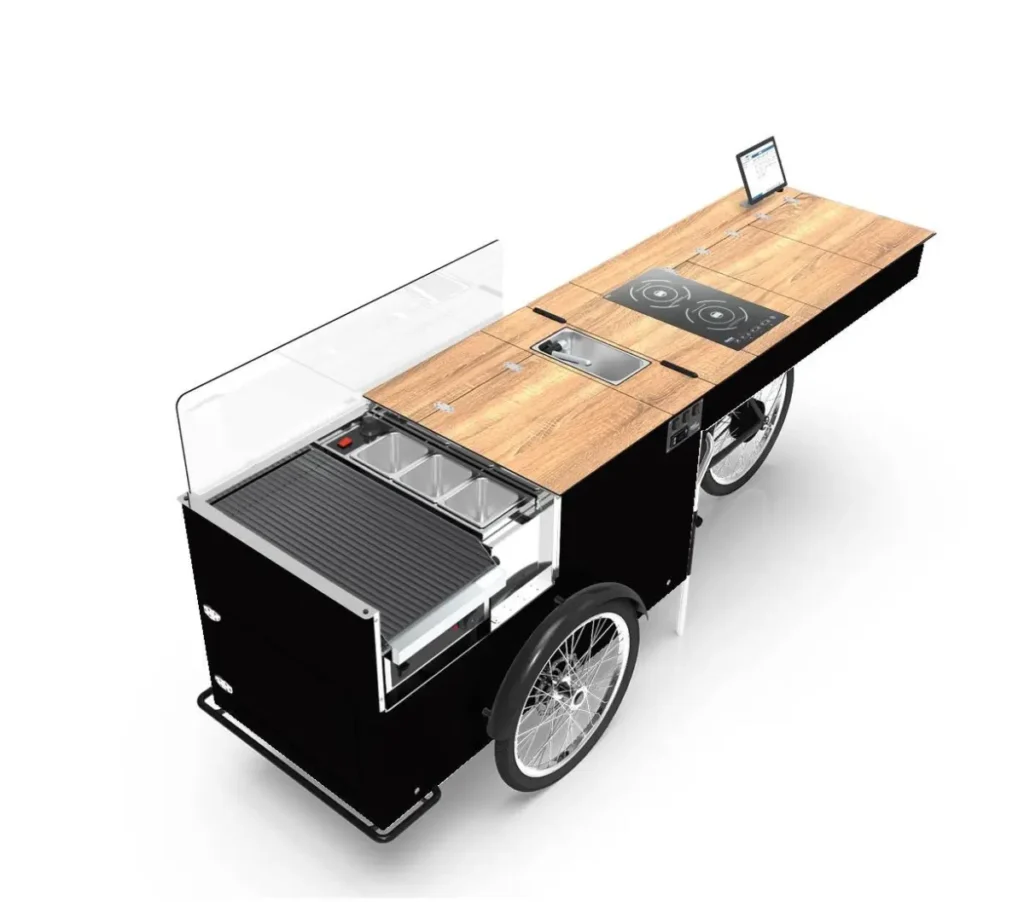
Our four families cover most use cases: cooking carts (1–2 stations), ice cream carts with battery refrigeration, beverage & beer carts with taps, and base carts you equip yourself. Browse all 19 configurations in the product catalog.
What a Food Truck Gives You That a Cart Can’t
Be fair to trucks: they carry full commercial kitchens — fryers, griddles, multi-basin sinks, exhaust hoods, and 6–10 meters of counter. If your concept is a 15-item menu at a busy lunch block doing 120 orders an hour, a cart physically cannot keep up. Trucks also work in rain and winter with customers served through a window, while carts mostly operate in fair weather unless sheltered. The food truck industry overview covers the segment well.
But the truck premium is enormous: a fully equipped truck costs 10–20 times a delivered cart. That capital could instead fund 5 to 15 carts in different locations — a portfolio strategy many operators now prefer.
Startup Cost Comparison
For a detailed breakdown see How Much Does a Food Cart Cost?. Summary:
| Cost Item | Food Cart | Food Truck |
|---|---|---|
| Equipment (factory-direct) | $1,800–$8,500 | $50,000–$150,000 |
| Shipping & import | $1,800–$3,000 | Included / $5,000+ |
| Permits & licensing | $100–$2,000 | $1,000–$10,000 |
| Insurance (year 1) | $400–$1,500 | $3,000–$12,000 |
| Total year-1 capital | $4,100–$15,000 | $54,000–$172,000 |
Permits and Health Regulations
Carts are usually licensed as pushcarts or mobile food stands — a simpler category than full mobile food vehicles. Many cities exempt carts from commissary kitchen requirements that trucks must meet nightly. US operators should check the FDA Food Code baseline and their county health department; the SBA publishes state-by-state licensing guides. In the EU, CE-compliant electrical systems (standard on our carts) simplify approval.
Power and Utilities: Battery vs Generator
This is the most underrated difference. A cart runs on a silent lithium battery bank — no fuel, no fumes, no noise complaints, and indoor venues will actually let you in. A truck typically runs a propane generator: $80–$200/month in fuel, regular maintenance, and restrictions at markets and parks. For ice cream and beverage service, battery-powered refrigerated carts run a full day on one charge.
Location Strategy: One Truck or Five Carts?
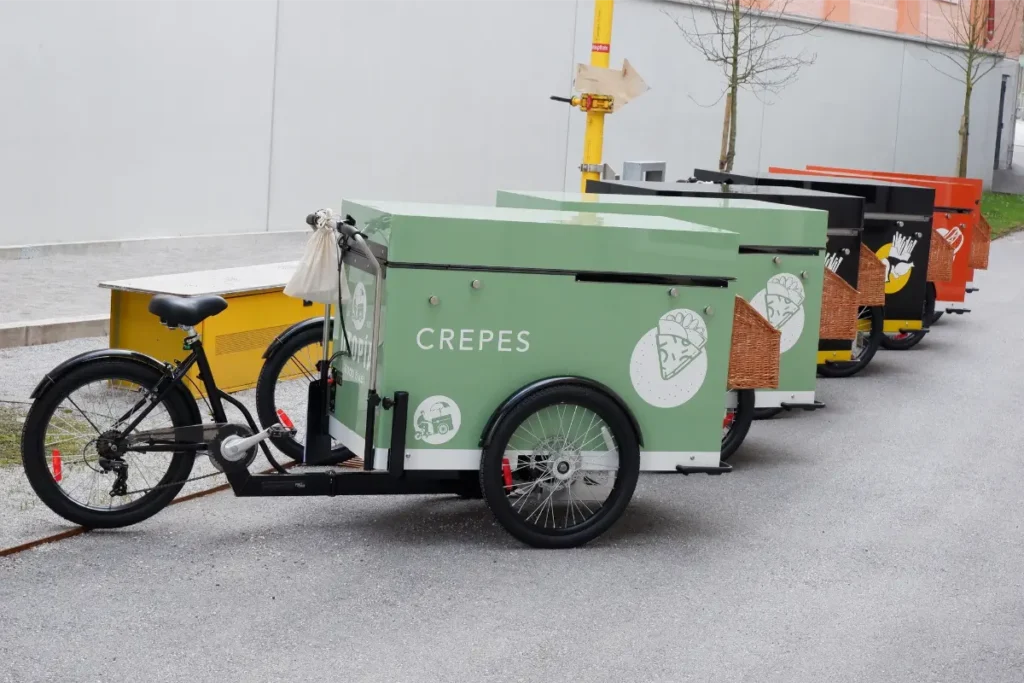
A truck is one location at a time. Five carts are five locations — or five events on the same Saturday. Rental operators buy carts in container quantities precisely because fleet economics beat a single premium asset. Our factory supports fleet orders with container-loading plans for 4–8 carts per shipment.
Which Should You Buy? Three Scenarios
Scenario 1: First-time operator, under $15,000
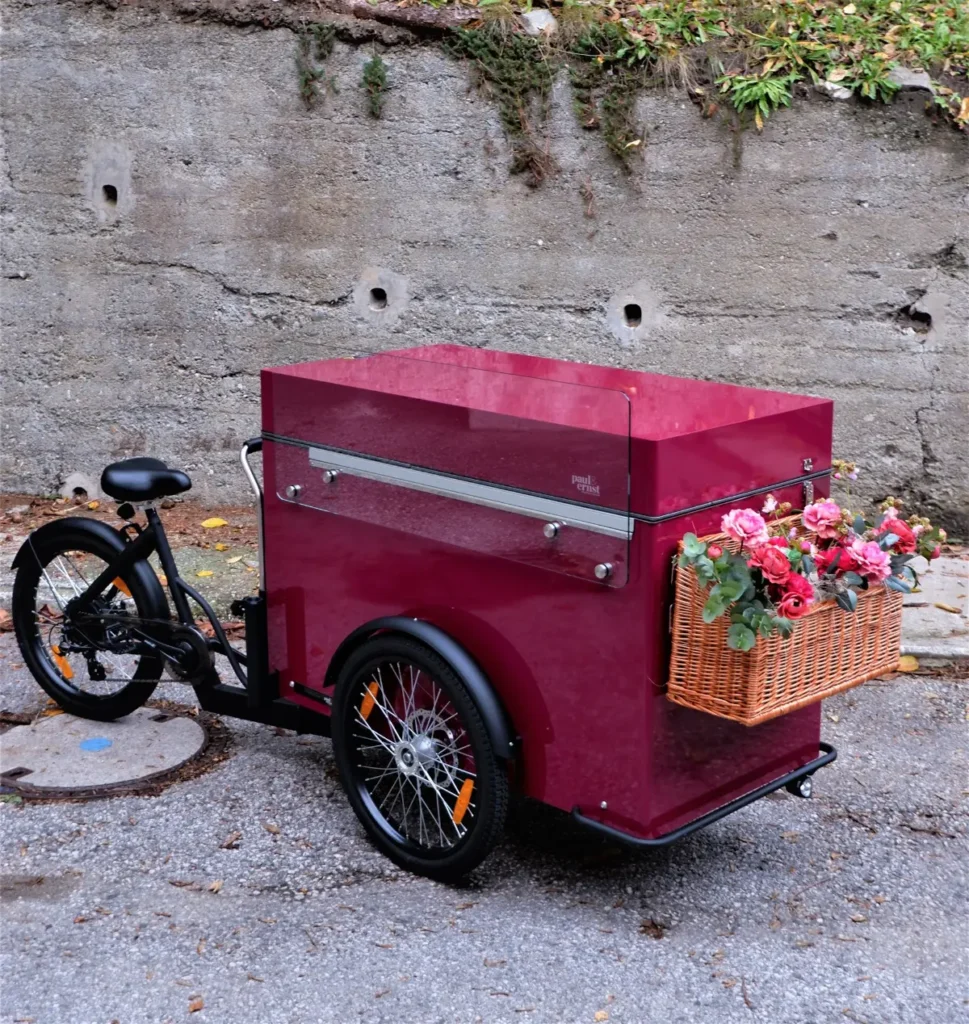
Buy a cart — specifically a single-station cooking cart ($3,000–$4,500 FOB) for a focused menu, or a base cart ($1,800) if you already own equipment. If the location fails, you relocate for $0; a failed truck is a five-figure write-down.
Scenario 2: Proven concept, scaling volume
If one cart is consistently selling out, add a double-stove cart at the same site or a second cart at a new site. Two carts ($9,000–$13,000 landed) still cost less than one-tenth of a truck and double your capacity.
Scenario 3: Full kitchen menu, 100+ orders/hour
This is the only case where a truck is the right answer. Alternatively, consider a beverage & beer cart for high-throughput drink service — taps pour far faster than kitchen items cook.
Recommended Carts (Truck Alternatives)
Five-Year Total Cost of Ownership: Cart vs Truck Side by Side
Purchase price is where the comparison starts, not where it ends. Here is a realistic five-year model for one operator running a single location, based on the numbers our customers report:
| Cost Item | Food Cart | Food Truck |
|---|---|---|
| Vehicle purchase (delivered) | $4,000–$10,000 | $75,000–$175,000 |
| Vehicle registration, insurance (5 yrs) | $0–$500 | $15,000–$35,000 |
| Fuel/energy (5 yrs) | $500 (battery charging) | $18,000–$30,000 |
| Maintenance & repairs (5 yrs) | $500–$1,500 | $15,000–$40,000 |
| Parking/storage (5 yrs) | $1,200–$6,000 | $6,000–$18,000 |
| Commissary kitchen (if required, 5 yrs) | $0–$15,000 | $15,000–$30,000 |
| 5-year total | $6,200–$33,000 | $144,000–$328,000 |
The gap is roughly 10–20x over five years. A truck must therefore find 10–20x the revenue of a cart just to break even on capital — which is why so many independent trucks migrate toward fixed pitches where a cart would have sufficed. The full cost breakdown for carts alone is in How Much Does a Food Cart Cost?
When a Food Truck IS the Better Choice
Honesty builds trust — there are three situations where we tell customers to buy a truck instead of a cart:
- Multi-stop daily routes with highway legs. If your model is breakfast at the business park, lunch downtown and dinner at the stadium — moving 20+ km between services several times a day — a self-propelled truck saves the labor of towing and re-pitching.
- Winter climates with no indoor venues. An enclosed, heated truck keeps a crew working through months when an open cart cannot trade. (Counter-point: many cold-climate operators simply park the cart November–March, and the low capital cost makes seasonal downtime affordable.)
- Regulations that specifically exclude pushcarts. A few cities restrict cooked-on-site food to enclosed mobile kitchens. Always confirm your city’s cart category before ordering — it is the one check you cannot skip.
For everyone else — fixed pitches, events, markets, campus and mall concessions, and rental fleets — the cart wins on cost, permitting, silence and setup time. If you are unsure which side you fall on, send us your city and concept via the contact page and we will tell you straight.
Setup Time and Daily Operation: The Everyday Difference
The cost tables capture capital, but operators feel the difference most in the daily rhythm. A typical service day on each platform:
- Cart: tow or push to pitch (5–10 minutes), level the jacks, flip the awning, power on batteries, stock the counters — ready in 15–20 minutes with one person. Pack-down is similar. No engine checks, no vehicle inspection, no commercial parking hunt.
- Truck: drive to pitch, find legal commercial parking, level the vehicle, run the generator or plug into shore power, complete any daily vehicle log — typically 40–60 minutes before the first sale, plus fuel and generator noise during service.
Over a 300-day season, the cart saves roughly 150–200 hours of setup labor — the equivalent of five extra full trading days. Battery carts also trade in noise-sensitive venues where generators are banned: malls, indoor markets, hospital plazas and evening festivals. That access, not the purchase price, is why many event organizers now list “silent power” as a vendor requirement.
If your intended locations fit those descriptions, the cart decision writes itself — start with the cooking cart range or the silent beverage cart, and cross-check permit categories in the cost and permitting guide.
Hybrid Strategies: Running a Cart and a Truck Together
The comparison is not always either/or. Established operators increasingly run a mixed fleet: a truck as the anchor kitchen at a fixed lunch spot, plus one or two carts for festivals, private events, and satellite pitches where the truck cannot legally park. The cart extends the brand into locations trucks are banned from, tests new menus cheaply, and keeps revenue flowing on days the truck’s spot is closed. The economics work because the two formats share commissary, staff, and supply chains while covering different demand curves. If you are planning a multi-unit operation, start with the format that matches your anchor location, then add the second format once unit economics are proven — the cost guide shows why carts are the lower-risk expansion unit, and our cooking cart range supports both standalone and fleet builds.
Budget discipline matters as much as format choice. Whichever platform you pick, lock your total project cost before the first deposit: cart or truck, fit-out, permits, commissary deposit, initial inventory, and a 10% contingency. Operators who cap the project at a written number and refuse scope creep during the build consistently reach profitability a quarter earlier than those who keep adding options mid-build. Write the number down, send it to your builder, and make the quotation line the contract line.
Frequently Asked Questions
Is a food cart cheaper than a food truck?
Yes — dramatically. A delivered food cart costs $4,000–$15,000 all-in versus $50,000–$175,000 for an equipped truck. Operating costs are also 4–5 times lower.
Can a food cart make as much money as a food truck?
Per unit, no — trucks serve more items per hour. Per dollar invested, carts usually win: 5 carts in 5 locations commonly out-earn one truck for one-quarter the capital.
Do food carts need the same licenses as food trucks?
Generally no. Carts fall under simpler pushcart/mobile-stand license categories in most jurisdictions, often without commissary requirements. Always verify with your local health department.
Which is faster to start — cart or truck?
A cart. Factory-direct carts ship in 10–15 days (custom 25–40 days) plus ocean transit; a truck build-out alone commonly takes 3–6 months before permits.
Can I upgrade from a cart to a truck later?
Yes, and the cart becomes your second location or a rental asset. Carts resell at 50–60% after two seasons, softening the upgrade cost.
Written by Mike, export sales lead at MAG-STAR CHEF. Still deciding? Send us your menu and city — we will recommend a cart configuration and itemized quote within 24 hours (WhatsApp +86 137 5771 7214).