Coffee is the most forgiving business a cart can run. The product is familiar, the equipment is standardised, the margin is high, and the customer returns every single day — which almost no food concept can claim. It is also the concept with the most hidden costs, because a coffee cart is really a small water treatment plant with an espresso machine bolted on top, and operators who budget only for the machine discover the rest of the bill after opening.
This guide sets out the full cost structure, the machine decision, the plumbing reality, a twelve-drink menu that covers most demand, realistic speed and margin benchmarks, and a twelve-month projection you can compare against your own numbers. For the platform itself, the cart layout guide explains how the interior plan changes when the menu is drinks rather than food.
Why Coffee Still Beats Most Cart Concepts
Three structural advantages make coffee the default first cart. First, repeat frequency: a lunch customer visits weekly, a coffee customer visits daily, so a good pitch compounds far faster. Second, predictable cost: green coffee, milk and cups fluctuate less than meat or produce, which makes margin planning reliable. Third, low waste: coffee and milk keep, and unsold stock does not have to be thrown away at closing the way prepared food does.
The trade-off is competition. Coffee is also the easiest concept to copy, which means the pitch and the brand carry more weight than the product. That is a marketing problem, not an operational one — and it is solvable, which is more than can be said for a menu that requires a full kitchen.
Startup Cost: What a Coffee Cart Really Costs
Budget in four blocks: the cart, the coffee equipment, the water and power systems, and the working capital to survive the first eight weeks. Operators routinely forget the fourth block, which is why profitable carts still fail in month two.
| Item | Typical range (USD) | Notes |
|---|---|---|
| Cart or trailer, fitted shell | 4,500 – 14,000 | Includes counters, cabinets, service window, basic electrics |
| Espresso machine (single or dual group) | 2,500 – 12,000 | Dual boiler and PID drive the top of the range |
| Grinder(s) | 500 – 2,500 | One per bean; a second grinder for decaf is worth it |
| Water treatment | 200 – 900 | Softener plus carbon filter; protects the boiler warranty |
| Refrigeration and ice | 800 – 2,500 | Under-counter milk fridge, ice maker or chest |
| Smallwares and cups | 600 – 1,500 | Tampers, pitchers, scales, lids, sleeves, signage |
| Branding and wrap | 800 – 3,000 | Cast versus calendered vinyl, signage, lighting, menu boards |
| Permits and inspections | 150 – 1,200 | Varies hugely by city; check before ordering |
| Working capital (8 weeks) | 2,000 – 6,000 | Beans, milk, cups, fuel, insurance, rent deposit |
A realistic all-in figure for a well-equipped single-operator cart lands between 13,000 and 40,000 USD. The wide range is not indecision — it is mostly the espresso machine and whether the cart is bought new or used. For a line-by-line comparison against food concepts, see the food cart cost guide.
The Espresso Machine Decision (and Its Power Bill)
Three machine classes cover almost every cart. A single-group heat-exchanger machine at 1,400–2,000 W is enough for 60–100 drinks a day and runs happily on a modest supply. A single-group dual-boiler with PID at 2,400–3,000 W gives stable temperature and simultaneous brewing and steaming, which roughly halves the queue at peak. A dual-group machine at 4,000–5,500 W is a shop machine: it needs a dedicated circuit, often a 30 A supply, and more water throughput than most carts can provide.
Match the machine to the pitch, not to ambition. A cart serving 40 drinks a day does not need a dual-group machine, and the extra 2 kW will be paid for twice — once in purchase price, and again in generator size or supply upgrade. Whatever the class, insist on a machine with a boiler that can be descaled and a group head that uses standard gaskets, so service parts exist locally in five years’ time.
The power plan deserves its own paragraph. Add machine, grinder, fridge, lights, till and any ice maker, then add 20% headroom. If the pitch has no mains supply, a generator sized to that total will be larger and noisier than expected — and noise is a real constraint at markets. The electric vs gas guide covers the trade-offs if you are also considering gas for a food component.
Choosing the Cart Platform
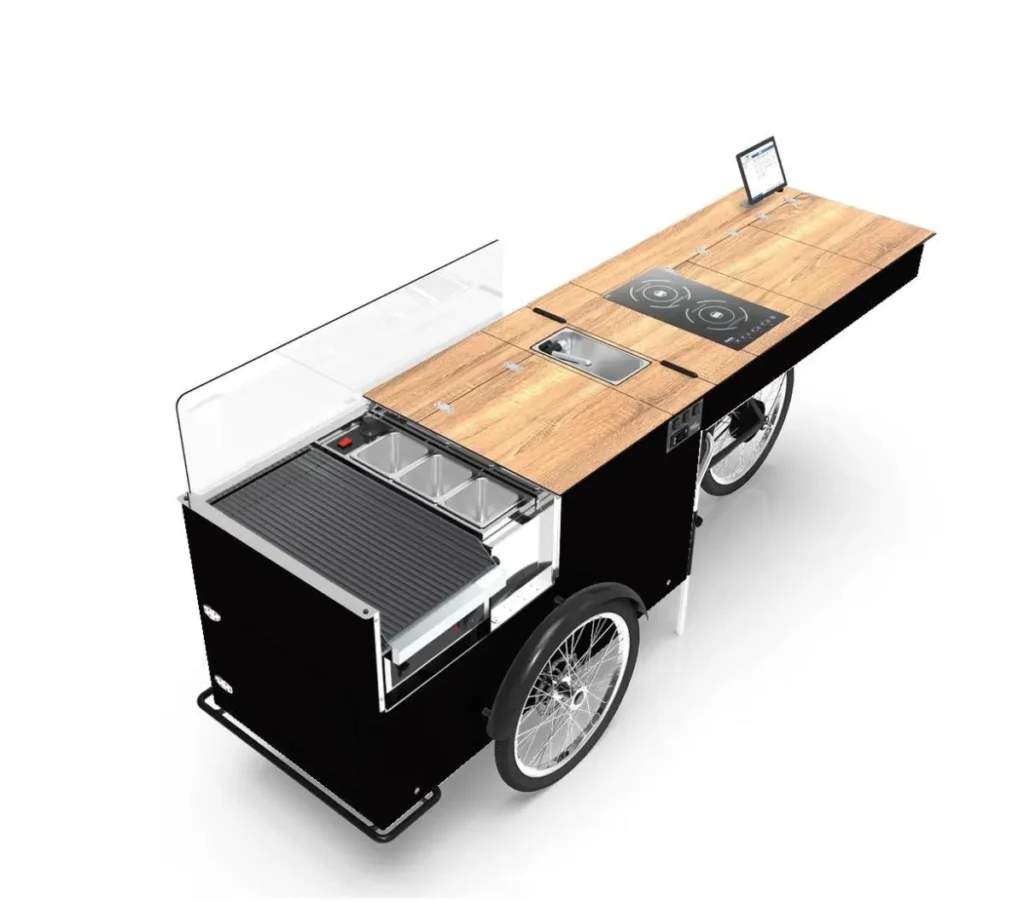
Coffee carts want counter length, not cooking stations. The ideal platform has a long service side for the machine, grinder, syrup rail and till, a low cabinet run for cups and lids, and an externally accessible bay for water tanks and gas or power. Our multi-purpose beverage cart is built on exactly that logic, and the beverage cart range shows the size variants.
Two alternative routes work. The single cooker cart can be reconfigured as a coffee platform if you plan to add a small food line later, and the multi-purpose base cart arrives empty for operators who want the interior built to their own drawing. Whichever you choose, confirm two numbers before ordering: the length of uninterrupted counter available for the machine and grinder, and the height of the service window relative to the customer’s hand. Coffee is passed across the counter hundreds of times a day, and a window 100 mm too high will be felt in the shoulder by Friday.
Water, Drain and the Plumbing Reality
Espresso machines need water at a stable pressure and a hardness low enough not to destroy the boiler. That means a pressure-regulated feed from a potable tank, a carbon filter, and usually a softener. Skip the softener in a hard-water city and the boiler will scale within a year; the repair usually costs more than the treatment system. The Specialty Coffee Association publishes the water chemistry targets the industry’s machines are designed around, and they are worth reading before you specify a filter.
On the drain side, most carts use a grey-water tank rather than a plumbed drain, because pitches rarely offer one. Size it generously: a busy coffee cart can produce 30–60 litres of grey water in a shift from flushing, cleaning and spillage, and a tank that fills at 14:00 ends the day early. A simple float indicator visible from outside saves the embarrassment of a mid-shift overflow.
Two smaller details separate professional builds from amateur ones: a handwash basin positioned before the service window rather than behind the machine, and a dump sink with a strainer, so milk residue and grounds never reach the grey tank. Both are cheap at build time and expensive to retrofit — the same lesson the layout guide applies to food carts generally.
The Menu: Twelve Drinks That Cover 90% of Orders
Long coffee menus are a vanity. Twelve drinks — espresso, americano, filter, flat white, latte, cappuccino, mocha, hot chocolate, iced latte, cold brew, tea and one seasonal — will satisfy almost every customer and can all be produced from the same machine, the same milk and three syrups. Everything beyond that adds decision time at the window without adding margin.
Keep the food side equally narrow: two pastries and one savoury item, bought in rather than baked. Baking on a cart consumes prep time, oven power and display space, and the margin is rarely better than a good wholesale pastry supplier. If you do want hot food, the menu planning guide sets out how to add one station without breaking service speed.
Speed of Service: The 90-Second Rule
Coffee customers tolerate a queue only if it moves visibly. Measure from greeting to handover: anything above 90 seconds at peak will cost you the third customer in line, who leaves without ordering. The table below is a working benchmark from real cart service, assuming one operator and a dual-boiler machine with two grinders.
| Drink | Target time | What slows it down |
|---|---|---|
| Espresso / americano | 30 – 45 s | Grinding to order without a second grinder |
| Flat white / latte | 50 – 70 s | Single steam pitcher; milk not pre-poured |
| Cappuccino | 55 – 75 s | Over-aeration; foam takes longer than texture |
| Mocha / hot chocolate | 70 – 90 s | Sauce in a jar instead of a pump |
| Iced latte / cold brew | 35 – 55 s | Ice scoop position; cups not pre-staged |
| Two drinks in one order | 90 – 120 s | Sequential rather than parallel steaming |
The three changes that reliably cut 20 seconds per order: pre-pour milk into pitchers during quiet moments, keep lids and sleeves within one reach of the handover point, and take payment while the shot is extracting rather than after. None require new equipment.
Margins: Where Coffee Makes Money
Coffee’s reputation for margin comes from the drink, but the money is in the mix. A 12 oz latte with milk costs roughly 0.45–0.75 USD in ingredients; priced at 4.00–5.50 it produces 82–88% gross margin. Pastries bought wholesale at 1.20 and sold at 3.50 produce 65%. Both are healthy — but the drink has a labour cost and the pastry does not, which is why the pastry often contributes more per second of operator time.
| Item | Cost | Price | Gross margin | Service seconds |
|---|---|---|---|---|
| 12 oz latte | 0.45 – 0.75 | 4.00 – 5.50 | 82 – 88% | 50 – 70 |
| Americano | 0.25 – 0.40 | 3.00 – 4.00 | 88 – 92% | 30 – 45 |
| Cold brew (bottled) | 0.90 – 1.30 | 4.50 – 5.50 | 72 – 80% | 15 – 25 |
| Wholesale pastry | 1.00 – 1.50 | 3.00 – 4.00 | 60 – 70% | 10 – 20 |
| Bottled water / juice | 0.40 – 0.80 | 2.00 – 3.00 | 65 – 75% | 5 – 10 |
Location Strategy for Coffee Carts
Coffee obeys the commuter clock. The best pitches are on a walking route between transport and workplaces, within 200 metres of a station entrance or a large office lobby, and open before 7:30. A pitch that is perfect at 11:00 but empty at 07:45 will underperform a mediocre pitch on the right route, because the morning occasion is 60–75% of a coffee cart’s revenue.
Secure the pitch before the cart. Most cities require a street trading licence tied to a specific location, and the good spots are often already licensed. Markets, business parks, hospitals and universities are usually easier entry points than high streets, and each offers a captive morning audience. Ask what the site’s footfall is at 08:00, not what it is across the day.
Permits, Inspections and Certifications
Every jurisdiction regulates mobile food, but the pattern is consistent: a trading licence for the pitch, a food business registration, an inspection of the unit, and evidence of water and waste arrangements. Equipment may need CE marking in the EU, NSF or ETL listing in North America, and gas certification where gas is used. Our certification guide lists what applies where, and the regulations by country guide covers the permit sequence.
Book the inspection before you buy stock. Inspectors care about handwash access, water capacity, temperature control and pest-proofing — all of which are design decisions. A pre-opening walkthrough costs a morning and prevents a re-inspection that can delay launch by weeks. The temperature and holding requirements inspectors work from are set out in the FDA Food Code, which most national codes mirror closely.
A Realistic Twelve-Month Projection
Assume a single operator, 22 trading days a month, an average ticket of 5.50 USD, and a gradual ramp as the pitch becomes known. The numbers below are deliberately conservative: a cart that hits these figures is viable, and one that beats them has found a better pitch rather than a better business plan.
| Month | Drinks/day | Revenue/month | Gross profit | Fixed costs | Owner earnings |
|---|---|---|---|---|---|
| 1 – 2 | 45 | 5,450 | 4,580 | 1,900 | 2,680 |
| 3 – 4 | 60 | 7,260 | 6,100 | 1,900 | 4,200 |
| 5 – 8 | 75 | 9,080 | 7,630 | 2,100 | 5,530 |
| 9 – 12 | 85 | 10,290 | 8,640 | 2,100 | 6,540 |
On a 25,000 USD total investment, break-even lands around month five at these volumes — consistent with the ROI and break-even guide for food carts generally. The variables that move it most are average ticket and morning footfall, not coffee cost.
Six Mistakes That Sink New Coffee Carts
- Buying the machine before the pitch. A great machine on a weak route cannot be saved by better coffee.
- Ignoring water treatment. The boiler fails, the warranty is void, and the repair costs more than the filter ever would.
- No second grinder. Decaf requests and single-origin upsells both require one; without it, both are lost.
- Oversizing the machine. A dual-group unit on a 40-drink pitch wastes capital and power.
- Opening at 08:30. The commuter window is gone by then; the cart spends the morning serving the wrong occasion.
- No cashless payment at the window. Card and phone payments now exceed cash at most pitches; a reader that takes 20 seconds loses the queue.
If you are deciding between a coffee concept and a food concept, the cart vs truck comparison and the eight-step launch guide will help frame the decision. For a quote on a coffee-ready platform with the water, power and counter layout already provisioned, send your pitch details through the contact page.
What a Coffee Pitch Needs From the Cart Itself
Not every beverage platform suits coffee, and the difference is measurable. Four dimensions decide it: uninterrupted counter length for machine and grinders, service window height relative to the customer’s hand, an externally accessible utility bay for tanks and electricals, and enough interior volume for cup stock without blocking the operator’s turn.
Aim for at least 1.2 metres of unbroken counter. An espresso machine occupies 500–700 mm, each grinder 200–250 mm, and the till and syrup rail another 400 mm — so a 1.2 m run is the practical minimum for a two-grinder setup. If the counter is interrupted by a hatch or a wheel arch, the machine ends up offset and the operator reaches sideways all day.
The utility bay matters more than buyers expect. Coffee carts carry fresh and grey water, a filter set, a consumer unit and often a generator connection. If any of that has to be reached from inside the cabin, restocking and servicing interrupt trade. Our beverage and beer cart is laid out with external access as standard, and the wider beverage cart range shows the size options.
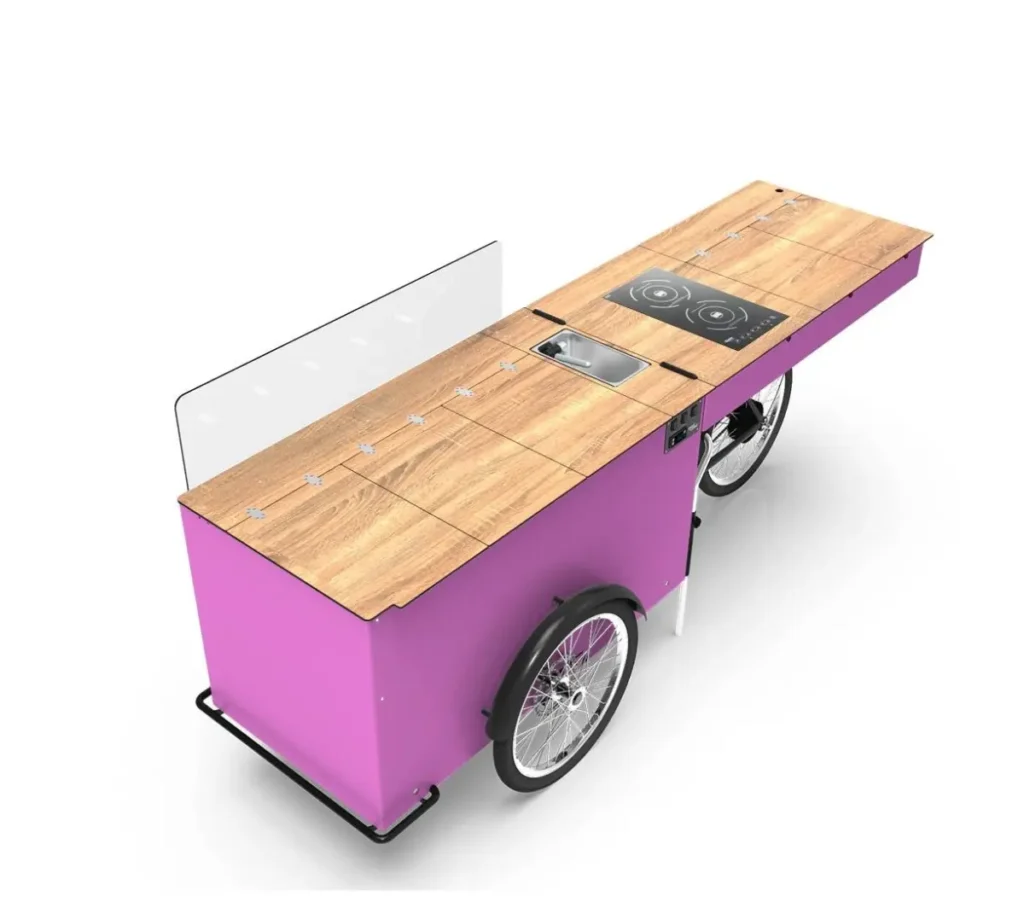
If the budget is tight, the multi-purpose base cart is the cheapest route to a coffee-ready shell, because the interior can be fitted locally to your own drawing — the layout guide covers what that drawing must contain.