Quick answer: The double-stove cooking cart is the workhorse of the mobile food industry: two independent burner positions on a stainless chassis, a water system with hand sink, battery or shore power, and a customization layer (awning, sign box, wrap, cold well) that turns the platform into almost any hot-food business. It fits operators who need menu range — griddle plus pot, fryer plus stove — and it is the cart we export most for burgers, kebabs, stir-fry and street-food menus worldwide.
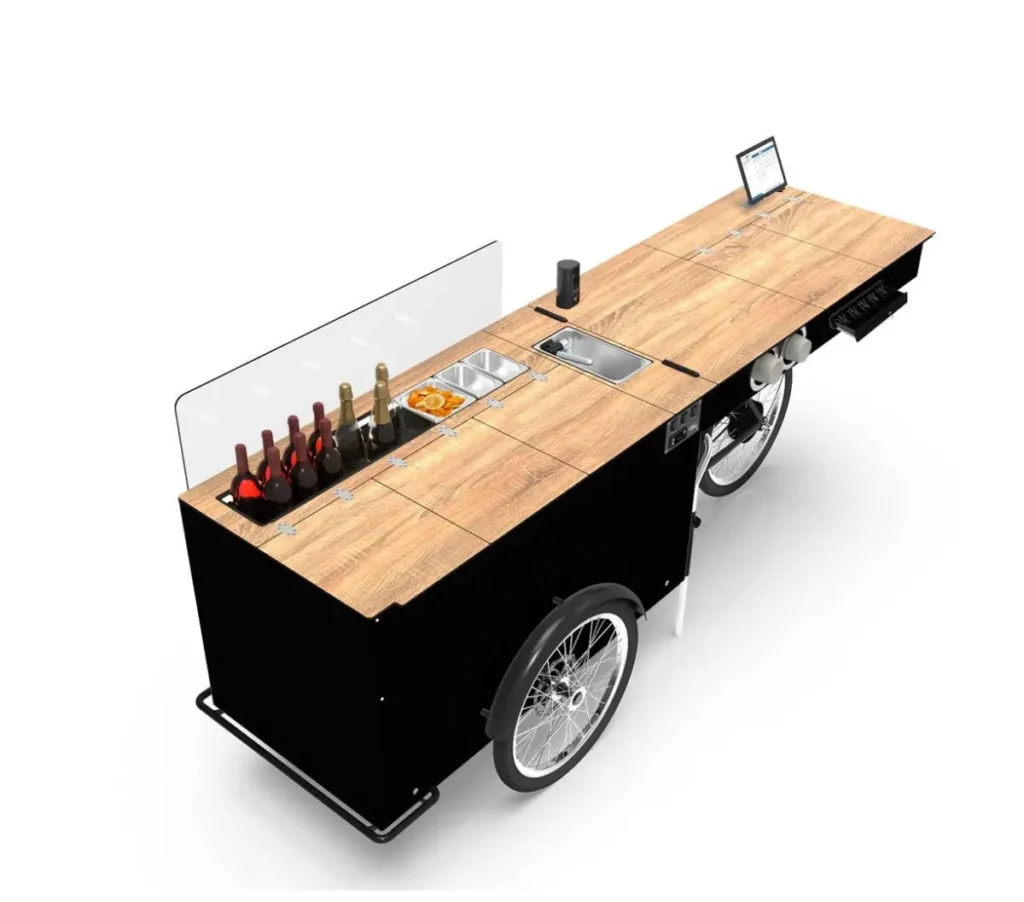
This guide documents the platform in the detail buyers ask for before ordering: standard specs, materials, power and water systems, the full customization menu, and the configurations that most customers actually choose. If you are still deciding between formats, start with what a food bike is, the cart vs truck comparison, and 2026 pricing.
What Is a Double Stove Cooking Cart?
A double-stove cooking cart is a purpose-built mobile kitchen with two separate cooking positions on one counter line. Each position takes a drop-in appliance — gas stove, induction cooker, grill plate, deep fryer, waffle maker or steamer — wired or plumbed to its own breaker and gas line, so the two stations run independently. Around the cooking line sit prep surface, hand-wash sink, storage shelves, a water system and the power bay.
The single-stove cooking cart serves focused single-item menus; the double-stove exists because most real street menus are not one item. Burger and drinks. Griddle plus soup pot. Fryer plus waffle. Two stations also give redundancy — if one appliance fails mid-service, the other half of the menu still sells.
Standard Specifications at a Glance
| Spec | Standard Build |
|---|---|
| Body | 304 stainless steel frame + food-contact counters |
| Cooking positions | 2 drop-in stations, independent breakers/gas lines |
| Power | LiFePO4 battery (2–5 kWh) + shore input, or gas-hybrid |
| Water | Fresh tank + hand-wash sink + waste tank, 12 V pump |
| Wheels | 4 heavy-duty casters (2 lockable), push/pull towing |
| Footprint | Approx. 2.0–2.4 m × 0.8 m counter line |
| Options | Awning, LED sign box, full wrap, cold well, shelving tiers |
| Certification | CE-marked electricals; leak-test cert on gas builds |
Exact dimensions vary with configuration — every quote ships with a dimensioned drawing before production starts, and the equipment guide explains how appliance choice drives the final layout.
The Two-Station Advantage: Menu Range and Throughput
Peak hours are where carts are won or lost, and two stations change the math. A single-station griddle cart serves burgers serially: order, cook, serve, repeat — about 2–3 minutes per item. A double-station cart runs the grill on one side and drinks or fried sides on the other, compressing the ticket to one pass. Operators report 40–60% higher peak throughput on two stations, which at $8–$12 tickets is the difference between a good Saturday and a great month.
The second benefit is menu economics: pair a high-margin anchor (griddled main) with an impulse item (waffle, drink, fried snack) and average ticket rises 20–35% without adding staff. The launch guide shows how to validate that menu before you commit the counter space.
Frame, Materials and Build Quality
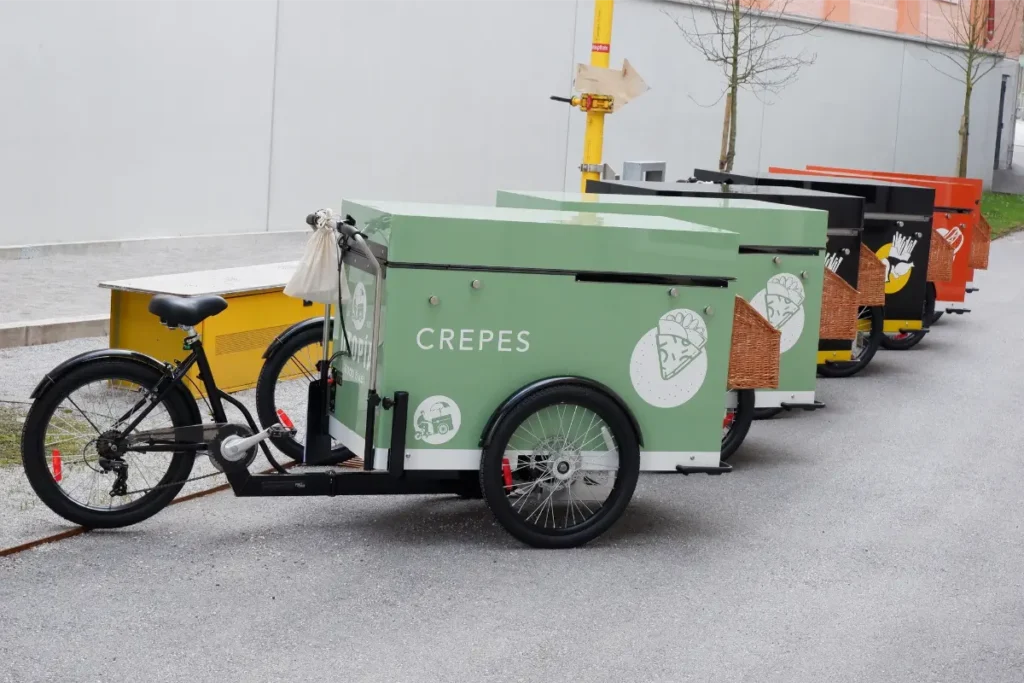
Every MAG-STAR CHEF double-stove cart uses a welded square-tube stainless frame with 304-grade food-contact surfaces — the grade health codes expect for prep and serving areas. Panels are double-skinned with insulation in hot climates; counters carry raised edges to contain spills; undershelves are rated for gas cylinders or battery banks with strapped retention. The chassis rides on four heavy casters (two braked) rated for full loaded weight, with towing eyelets for short vehicle repositions. Before export, each cart passes an 18-point inspection — weld integrity, circuit load test, water pressure test, brake function — and ships with photo documentation, the same process shown in our factory walkthrough materials.
Power Systems and Wiring
The standard electrical build is a LiFePO4 battery bank feeding a distribution panel with one labeled breaker per appliance — the same architecture described in our electric vs gas comparison. On the double-stove, the two cooking stations each get an independent breaker so one fault never kills the whole counter. Gas-hybrid builds add a sealed cylinder bay with external access, regulator and shut-off valve per burner line. All electrical components are CE-marked, wiring runs are loomed and grommeted, and a shore-power inlet charges the battery and feeds appliances directly when parked at an outlet. For buyers planning generators instead: we advise against it for cart builds — vibration, noise rules and fuel logistics erase the price advantage within a season.
Water System and Hygiene Compliance
Open food service almost universally requires a dedicated hand-wash sink with hot water, and the double-stove platform carries a full water system as standard: fresh tank, 12 V demand pump, instant water heater, hand-wash basin and a waste tank sized to outlast the fresh tank. Counters in the prep zone are coved to the backsplash for wipe-down, and a closed waste bin mounts under the counter. For dairy or high-risk menus, add a NSF-style sealed cold well next to the cooking line. US operators can benchmark against the FDA Food Code; the sink-plus-hot-water rule is the one inspectors check first, so we treat it as non-optional in every build.
Customization Options
- Awning — retractable, branded; shade for product and staff, and the visual flag customers spot from distance.
- LED sign box — illuminated menu/logo panel; the highest-visibility upgrade for evening trading.
- Full vinyl wrap — applied at the factory from your artwork for $200–$800 versus $800–$2,000 locally.
- Cold well / refrigerated display — adds drinks and desserts next to the hot line; the single biggest ticket-lift option.
- Shelving tiers and gantry — display and storage above the counter line without growing the footprint.
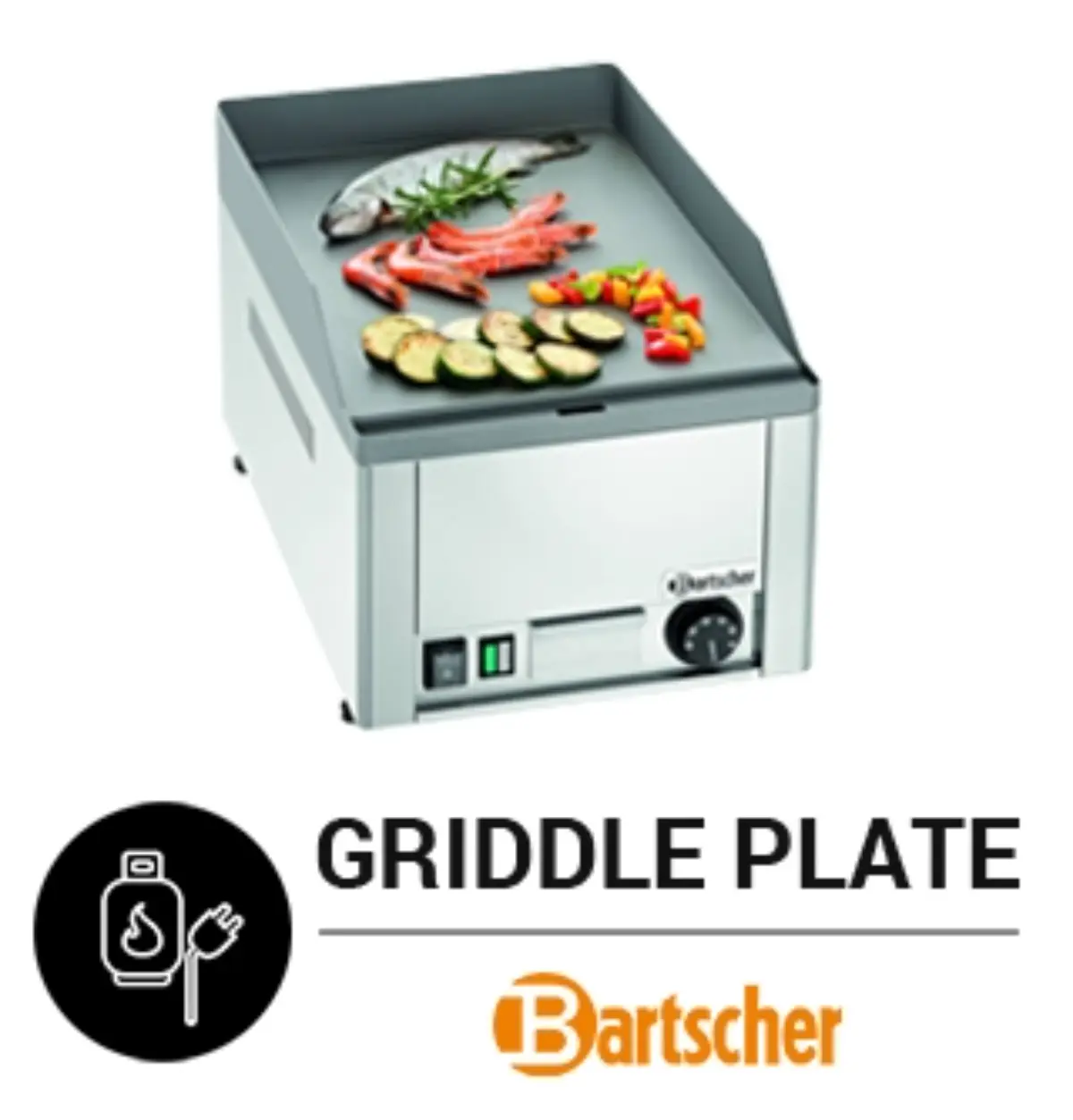
- Appliance swap — any drop-in from the cooking equipment catalog fits the two stations: grill plate, fryer-grill combo, pancake griddle, contact grill and more.
Configurations Customers Actually Order
| Concept | Station A | Station B |
|---|---|---|
| Burger stand | Grill plate (gas) | Deep fryer |
| Kebab & wraps | Striped grill plate | Induction (sauces) |
| Asian street food | Gas burner (wok) | Steamer |
| Breakfast cart | Pancake griddle | Electric pot (eggs/coffee) |
| Dessert bar | Waffle maker | Cold well (ice cream) |
Shipping, Assembly and First Service
Double-stove carts ship fully assembled in a reinforced plywood crate, one cart per fraction of a 20 ft container — typically 3–5 carts per container depending on options. Assembly at arrival is minimal: unpack, fit the wheels if removed for crate height, connect the gas regulator if applicable, charge the battery and run the commissioning checklist we supply (circuit test, leak test, water flow). Most customers trade within a day of the crate arriving. Freight, import duty and assembly are itemized separately in every quote so you can see the true landed cost before committing — the same transparent breakdown used in our cost guide.
Who the Double-Stove Cart Is — and Is Not — For
Choose it if: your menu has two temperature profiles (grill + cold, fryer + pot), you trade peak-hours where throughput pays, or you want redundancy on a remote pitch. Choose the single-stove cart if your concept is one hero item and capital is tight; choose the base cart for cold menus and retail display; and if your ambitions outgrow two meters of counter, read the cart vs truck analysis before scaling. The double-stove sits at the sweet spot: truck-grade menu capability at cart-level cost and permits.
Worktop Workflow: Designing the Counter Left to Right
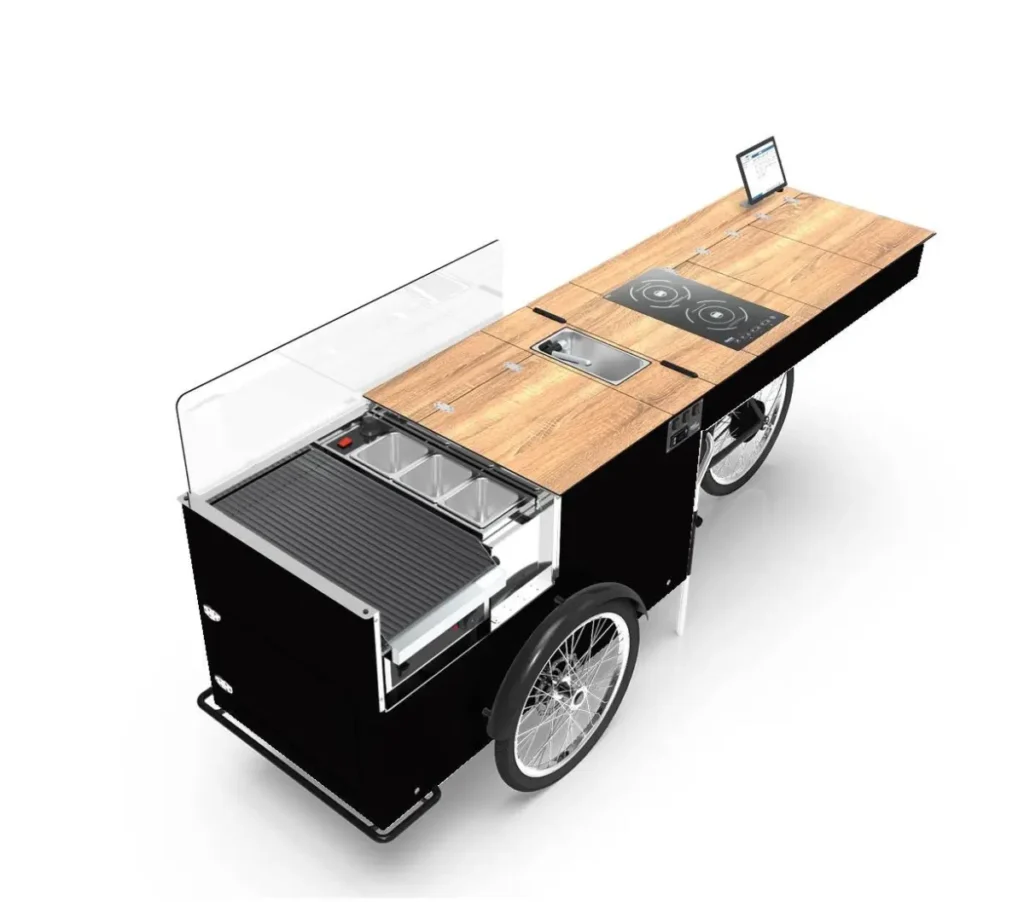
The difference between a cart that flows and one that fights you is workstation order. The proven sequence runs left to right: raw prep and storage on the entry end, cooking stations in the middle, plating and service on the customer end, with the hand-wash sink where hands are most often needed — between the raw and cooked zones. On a two-station cart this means the slower station (oven-type, steamer, pot) sits furthest from service and the fast station (grill, fryer) sits nearest, so the operator’s last motion before handing food across the counter is finishing, not walking. Menu assembly happens in one direction with no backtracking, which cuts per-order handling by a third. During the quote stage we draw your counter as a scaled top-view with your actual appliance cutouts — move the boxes on paper before they are welded in steel. Bring your service script (“order, grill, dress, wrap, drink”) to the drawing and the layout will come out right the first time.
Upgrades Worth the Money (and Ones to Skip)
After fitting out hundreds of double-stove carts, the option list sorts itself clearly. Worth every dollar: the cold well (sells drinks and desserts from the same footprint, typically the fastest payback option we install), the LED sign box (evening trading lives or dies on visibility), the awning (product protection plus a 50-meter visual flag), and factory-applied branding wrap (a quarter of local cost, better quality). Skip or defer: built-in sound systems (portable speakers do it better), oversized battery banks beyond your load sheet (you are buying weight, not hours), and elaborate multi-tier gantries that block the sight line to your sign. The unglamorous middle tier — extra shelving, a second waste bin, better caster specification — costs little and prevents daily annoyance. When you send your spec, mark must-haves versus nice-to-haves and we will quote both so you can see exactly what each option does to the landed price.
Permit and Inspection Notes for Two-Station Carts
Two cooking stations do not mean double the paperwork, but they do concentrate the inspector’s attention on three points. First, each appliance needs its own clearly labeled breaker or gas line — shared, unlabeled circuits are the most common failure we see on locally retrofitted carts and the reason factory-fitted wiring passes while retrofits come back with punch lists. Second, the hand-wash sink must be independent of food prep water and stocked at inspection time (soap and towels included — inspectors check). Third, gas builds need the cylinder bay certificate and, in most jurisdictions, an on-site leak test at registration. Prepare a one-page equipment schedule listing each appliance, its power draw and its breaker label; hand it to the inspector first and the visit usually ends in minutes. Every MAG-STAR CHEF cart ships with that schedule pre-printed, plus the leak-test certificate and CE declarations — the exact document set described in our launch guide inspection section.
For operators researching standards before ordering, two references are worth bookmarking: the FDA Food Code for US health-code baseline and ISO 22000 for food-safety management vocabulary. You do not need certification to trade from a cart, but speaking the standards language shortens every inspection and every corporate catering negotiation — and our factory documentation is written to those references so your local officials can match line items quickly.
Frequently Asked Questions
How much does a double-stove cooking cart cost?
$3,800–$7,500 FOB depending on appliances and options, plus freight and import duties (typically 15–30%). See the full breakdown in our cost guide.
Can I run one gas and one electric station on the same cart?
Yes — the hybrid layout is our most popular export build: gas burner for searing power, induction or electric pot for the second station, each on its own independent line.
What appliances fit the two stations?
Any drop-in unit from our cooking equipment catalog: grill plates, fryers, waffle makers, steamers, induction cookers, heating pots and contact grills. Stations are dimensioned to standard appliance cutouts.
Does the cart include a sink and water heater?
Yes, every double-stove build ships with fresh/waste tanks, 12 V pump, instant heater and a dedicated hand-wash sink — the requirement most health codes check first.
How long does production take?
Standard builds leave the factory in 15–25 days; heavily customized builds run 30–40 days. Sea freight adds 15–35 days depending on destination.
Written by Mike, export sales lead at MAG-STAR CHEF. Request a dimensioned drawing and itemized quote via the quote desk (WhatsApp +86 137 5771 7214).